|  | 
 July 4, 2005 July 4, 2005 |
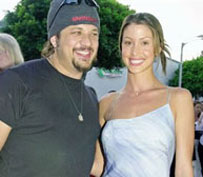
Los Angeles, CA Whit Pistol One of Ted Ted's most desirable women (right) and some schlub who tricked her into marrying him (right) at some big Hollywood to-do.
Elizabeth, most famous for her beautiful face and gravity-defying breasts, has appeared in two of the otherwise-insufferable American Pie movies and Jay and Silent Bob Strike Back, while husband Reitman, most famous for somehow bedding Playboy-quality ass despite having no real movie credits to his name, has appeare...
ollywood mourned the loss of another great couple this week, when super-hottie Shannon Elizabeth filed for divorce from the incredibly fortunate guy she married years ago. Citing "irreconcilable differences," not the awful Shelley Long movie, but the standard divorce patter for the sex life went to shit, the couple ended their three-year marriage, leaving Elizabeth to go back on the market and husband something Reitman to sink further into anonymity.
Elizabeth, most famous for her beautiful face and gravity-defying breasts, has appeared in two of the otherwise-insufferable American Pie movies and Jay and Silent Bob Strike Back, while husband Reitman, most famous for somehow bedding Playboy-quality ass despite having no real movie credits to his name, has appeared next to Elizabeth in a few photographs and not much else.
Some speculate trouble started on the set of Ashton Kutcher's M-TV show Punk'd, where trouble usually starts in Hollywood, when Reitman attempted to punk the brunette sexpot; but friends of the couple suggest the punking had been going on for months beforehand, and the couple spent more time by themselves than together, leading to the marriage's disintegration.
Elizabeth's pending divorce makes her available to enter the dating scene again, opening the door for relationships with attractive rock stars, hot Hollywood hunks, and even diminutive alternative news website reporters with charming vestigial wings.
The Shannon Elizabeth divorce from the formerly lucky fuck is only the latest in a string of super-hot celebrity babe news this week, including the deeper sinking of Katie Holmes into the world of science-fiction religion.
Fresher news also has Alias star Jennifer Garner wedding millionaire dope Ben Affleck in a secret Carribean wedding. Affleck, a renowned babe bagger with a track list including Gwyneth Paltrow and Jennifer Lopez, began dating Garner after his relationship with J-Lo flamed out, and he desperately wanted to find someone to fulfill the "nifer" part of his famed "Bennifer" moniker. The wedding comes as no surprise to hot chick watchers, as rumors have circulated for weeks that Garner may be pregnant with the seed of Affleck. Biologists, at least those of us who have a high school biology background, speculate the baby will either be a super-sexy spy or a really bad actor.
Also on the Ted Ted short list of fine asses to watch, Tomb Raider and sexual fantasy star Angelina Jolie was photographed with rich male hottie Brad Pitt, further fueling speculation the two were the source of friction that ended Pitt's marriage to Hollywood TV honey Jennifer Aniston.
On a sadder note, picky religious nutjobs found fault with sculpted super-beauty Jessica Simpson after the debut of Simpson's semen-inducing video for "These Boots Are Made for Walking," where Simpson is seen washing a car alá home video queen Paris Hilton's infamous Carl's Jr. commercial, in the guise of her Dukes of Hazzard role of Daisy Duke. The alarmed Baptists condemned the lovely jezebel as parading around all "slutty" and demanded she make a cleaner version of the video. Ted Ted, in response, demanded they burn in hell for ruining his good time.
In the meantime, Shannon Elizabeth asked for privacy during this very personal time, and could not be reached for response since this reporter did not have her number, no matter how desperately he keeps asking the publicist for it. the commune news thinks this objectifying of women is a horrible thing, at least when they're unattractive. Speaking of unattractive… well, let's just say Ted Ted's office is tucked way in the back of an unlit broom closet.
 |
Tony Dow up 30 stories; expected to plummet
 Polish Roof Falls in Following "Drinks Are on the House" Debacle
NASCAR accepts hard liquor revenue; drivers accept hard liquor
God joins War on Terror in Pakistan
|
Turkey to Block Offensive Websites; commune Offers Pre-Emptive “Fuck You” Obama to Change Spelling of Name to oBAMa for Maximum Impact Oasis, Killers Combine Forces to Ruin Sgt. Pepper’s for Everyone Global Warming Poses Threat to National Parks, Says WWF’s “Machoman” Savage |
| |
| 
 April 2, 2007
Nobody Knows How to Have a Good Time Any MoreI'm serious, take a look around you. Do you see anybody having a good time? No fair answering if you're in Cuba or some central-American country. You people live life on a whole different level, and it's easy to have fun 24-7 when the value of a human life is on par with a bag of Cheetos. I'm talking about folks here on the white side of the world, the one noticeably light on the conspicuous enjoyment of not being dead.
When's the last time you saw some happy motherfucker tearing down the Vegas strip with the top down, firing a machine gun randomly into the air while the X-ed out girl scout behind the wheel struggles to keep it on the road? Not size last July, I don't get to Vegas as often as I used to.
But answer me this, when's the last time you saw a married father of four welding runners to the bottom of the minivan, and taking the whole family out for a sledding ride down the biggest hill in town and across the lake that may or may not be frozen all the way across? Hardly ever happens any more. My dad used to pull that shit constantly, one time it wasn't even winter. Back then people knew how to make a game of life and death. You ever see films from back then? Everybody smoked, they didn't care if they lived or died. When you were pregnant you smoked more, because you were smoking for two. And the cars back then! Seat belts? Why would you want to be strapped down to a flaming hunk of metal when the family in the other car got the ride of...
º Last Column: Charity Case
º more columns
I'm serious, take a look around you. Do you see anybody having a good time? No fair answering if you're in Cuba or some central-American country. You people live life on a whole different level, and it's easy to have fun 24-7 when the value of a human life is on par with a bag of Cheetos. I'm talking about folks here on the white side of the world, the one noticeably light on the conspicuous enjoyment of not being dead. When's the last time you saw some happy motherfucker tearing down the Vegas strip with the top down, firing a machine gun randomly into the air while the X-ed out girl scout behind the wheel struggles to keep it on the road? Not size last July, I don't get to Vegas as often as I used to. But answer me this, when's the last time you saw a married father of four welding runners to the bottom of the minivan, and taking the whole family out for a sledding ride down the biggest hill in town and across the lake that may or may not be frozen all the way across? Hardly ever happens any more. My dad used to pull that shit constantly, one time it wasn't even winter. Back then people knew how to make a game of life and death. You ever see films from back then? Everybody smoked, they didn't care if they lived or died. When you were pregnant you smoked more, because you were smoking for two. And the cars back then! Seat belts? Why would you want to be strapped down to a flaming hunk of metal when the family in the other car got the ride of their lives, finally seeing what it's like to fly? Cars back then were awesome, they drove fast, idled heavy and stopped infrequently. Their idea of a safety feature back then was making the cigarette lighter hole narrow enough a kid could only fit two or three fingers in there. No need to burn off all a kid's fingers just to teach 'em a lesson about curiosity, you know what I'm sayin? Hell, back then a windshield was an option. If your parents were cheap it meant you got an unobstructed view of the road, and it was like having a dashboard that was four feet deep. Do you have any idea how much shit you could fit on a dashboard like that? Lunch, dinner, a toaster, entire battalions of army men, and more than enough bottle rockets to shoot at any oncoming cars you might see on the drive. The hood was like a wonderland for kids back then. Nowadays what do kids get? A GameBoy and some motion sickness pills. Pardon me if I don't keel over with envy. You know what people did back then if they were depressed or had emotional problems? They sure as hell didn't piss away the hours in some hazy Prozac twilight like they do now. No, back then if you had a problem, you hit the bottle, and you hit it hard. You ever hear stories about somebody's dad getting ripped on Prozac and tearing around the neighborhood in reverse, all four doors open, lassoing stray neighborhood dogs just for the shit of it? Of course you don't. Doesn't happen. But that kind of shit was happening nightly in my house growing up. Those were the days. Nowadays if you want to have a good time and not spend the weekend in jail over it, you practically have to go down to Mexico with a trunk full of stun grenades and one of those guns that shoots nets like they use on Rush Limbaugh when he goes on one of his painkiller sprees. Down there, they don't give a shit. It's like a throwback to simpler times here in the States, back when people were too busy keeping the family alcoholics from getting everybody killed to worry about what you were up to, with your sneaking around at night and painting crosswalks on the freeway and whatnot. Have we really made progress in all these years? Are you shitting me? Mexico's a reliable supply of drinking water away from overtaking us as the place to live for free-thinkers and the bold of heart. Don't say I didn't warn you when you're seeing whitebread families from Iowa on the news, getting caught trying to sneak across the desert into Mexico in the dead of night. I give it about five years. º Last Column: Charity Caseº more columns
| 
| September 1, 2003
Admit it, You Think Cancer is FunnyCancer's just not as funny as it used to be. I mean, seriously, remember when cancer used to be hilarious? Like dad would come home from work and you'd be like "How's your day, pops?" and he'd say "Just found out my liver's rotted through with cancer!" and you'd both laugh and laugh? Those were the days.
Nowadays you have to pretend like it's breaking your heart that somebody's going to start pooping out lungs soon and you can't even giggle when they're moaning "I'm dyin' here, I'm really dyin'!" It's a total drag. People just don't have any kind of sense of humor about themselves anymore, everything's all "Woe is me, I live out every moment in agonizing pain." Thanks a lot for bringing me down, asshole. I just spent four bucks on this ice cream for nothing.
When I was a kid, if one of your classmates had cancer you were allowed to push him down the stairs and say his dad's a fag; that made you popular. And I don't remember the kids with cancer complaining, they just appreciated the attention. That's all anybody who's got three months to live wants, anyway, is attention. It shouldn't matter if it's "pretending to listen to all your crybaby stories" attention or "pushing you in your wheelchair off a ski jump" attention, that's really splitting hairs. And hey, don't give me all that sore-loser bullshit about your wheelchair being all ruined now, if you hadn't bet on yourself you'd have plenty of money to buy another one. I know I do.
º Last Column: I Just Wanted a Card That Said "Sorry For Kicking Your Grandma in the Kidneys"
º more columns
Cancer's just not as funny as it used to be. I mean, seriously, remember when cancer used to be hilarious? Like dad would come home from work and you'd be like "How's your day, pops?" and he'd say "Just found out my liver's rotted through with cancer!" and you'd both laugh and laugh? Those were the days. Nowadays you have to pretend like it's breaking your heart that somebody's going to start pooping out lungs soon and you can't even giggle when they're moaning "I'm dyin' here, I'm really dyin'!" It's a total drag. People just don't have any kind of sense of humor about themselves anymore, everything's all "Woe is me, I live out every moment in agonizing pain." Thanks a lot for bringing me down, asshole. I just spent four bucks on this ice cream for nothing. When I was a kid, if one of your classmates had cancer you were allowed to push him down the stairs and say his dad's a fag; that made you popular. And I don't remember the kids with cancer complaining, they just appreciated the attention. That's all anybody who's got three months to live wants, anyway, is attention. It shouldn't matter if it's "pretending to listen to all your crybaby stories" attention or "pushing you in your wheelchair off a ski jump" attention, that's really splitting hairs. And hey, don't give me all that sore-loser bullshit about your wheelchair being all ruined now, if you hadn't bet on yourself you'd have plenty of money to buy another one. I know I do. Don't forget that other cancer dude who smoked you on the ramp is living the good life over in the traction ward, and you know he's not complaining. What really gets me though, are all these bleeding-heart liberals who don't even have cancer but still get their Volvos in a bunch when I think something's funny. Like when that commercial comes on in the theater, before the movie, with all the bald little kids talking about cancer research and blah blah blah. Now that's some funny shit! You see those kids? They're balder than my dad, and they're only like five! Where do they find those freaks? I'm telling you, I could watch that shit all day if I didn't have a theater full of Good Samaritans pelting me with popcorn and booing and shit. Please. Like any of them had cancer when they were kids. I tell you, the world's full of people trying to ruin my good time. If it's not some pastel-colored killjoy petitioning to cancel a hilarious show like World's Greatest Police Chases, it's some other curmudgeon telling me I can't visit the fat camp unless I'm a family member. I tried telling that guy they should charge admission, because I know at least a dozen guys who would bust a nut watching those lard-assed little kids try to run an obstacle course and falling down and having asthma attacks and shit, but wouldn't you know he's one of those lost-cause fruits who puts a child's "dignity" ahead of profit. Like any of those little butterbutts wouldn't trade his or her dignity for a big slice of pie. He didn't think that was funny either, and the bastard confiscated my pie. I tell you, it's a lonely life, being one of the only guys out there with a sense of humor. And hey, it's not like I fail to see the humor in my own misfortune. Just last week, some lady's little yappy dog ran out in front of my truck and just creamed the thing, made a real mess of the front end. And I had just washed the damn thing. But did I mope around, like the world had just crapped in my salad? No way, I laughed my ass off! Did you see how far that little dog flew? Jesus Christ, I thought that thing was some kind of rubber dog for a second there! Holy shit that was funny. º Last Column: I Just Wanted a Card That Said "Sorry For Kicking Your Grandma in the Kidneys"º more columns
|

| |
Quote of the Day“No one ever went broke underestimating the intelligence of the people; except, of course, for those people who keep giving Tony Danza a TV series.”
-H.M. LincolnFortune 500 CookieOur deepest condolences for your loss—but cheer up, there will be another Powerball lottery before you know it. Taco Bell wasn't fucking with you about that protection money, as you'll find out this week. You were right: you should have weighted that body down better. Lucky feathers this week: Condor, goose, anything Elton John wore in the '70s.
Try again later.Least Heard Mobster Euphemisms for Murder| 1. | Treat this guy to a steel sundae | | 2. | Make his shoes a lot heavier, more sinkable | | 3. | Invalidate his parking | | 4. | Go apeshit on this fuck | | 5. | Fill him full of holes like a Dade County ballot (2000 only) | |
|   North Korea Pissed Their Real-Life Hunger Games Nowhere Near as Popular as Movie BY V.D. Whistling 11/25/2002 Harvey Potluck and the Rolling StoneIt was on his twelfth birthday that Harvey Potluck was visited by Gorgeous Gorge, the sex dumpling. A sex dumpling is a very large and burly woman with reverse genitals and a beard, making people consider it a man when in fact it's an it. "Sex dumpling" is a rather unfortunate term, really, but that's what happens when your race is discovered by a large group of drunken fraternity fellows from Jordasche-Upon-Fathips.
Gorgeous Gorge, the sex dumpling, had come from Hogwash Military Academy and Magic Technical School for Harvey Potluck according to his dead parents' wishes. That is to say, the parents made such a plea on Harvey's behalf before their demise. Harvey knew nothing of his parents; he lived with his evil foster parents who kept him living in a bottle as a...
It was on his twelfth birthday that Harvey Potluck was visited by Gorgeous Gorge, the sex dumpling. A sex dumpling is a very large and burly woman with reverse genitals and a beard, making people consider it a man when in fact it's an it. "Sex dumpling" is a rather unfortunate term, really, but that's what happens when your race is discovered by a large group of drunken fraternity fellows from Jordasche-Upon-Fathips.
Gorgeous Gorge, the sex dumpling, had come from Hogwash Military Academy and Magic Technical School for Harvey Potluck according to his dead parents' wishes. That is to say, the parents made such a plea on Harvey's behalf before their demise. Harvey knew nothing of his parents; he lived with his evil foster parents who kept him living in a bottle as a conversation piece. Keep in mind this was not modern-day logical Britain where such cruel parents would be charged with abuse and neglect and sent to prison for the remainder of their natural lives, but some mythological Grimm Brothers Britain where nasty foster parents are allowed to raise book heroes to evoke a natural sympathy for them in their efforts.
Let's just skip the annoying details of how Gorgeous Gorge gave the rueful stepparents their come-uppance and took Harvey to Hogwash Tech so we can get to the really good bits of dragon dogs and the enchanted toilet brush.
Harvey was all bewildered and shit by his entrance into Hogwash Tech. There were many strange things and peculiar sights to witness as soon as he stepped through the crusty iron gates. He saw duplication fights, where one young student would start a fight with another, then duplicate himself into dozens of clones and beat the bejesus out of the other student. There were Bodpickle matches, where students whipped out their Bodpickles and extended them as far as they would go—usually the black witches won without challenge. And, of course, all of them played Magic: The Gathering.
So, so odd to Harvey it all was, little did he dream that ugly birthmark on his ass would mark him as the premiere student of Hogwash Tech, and by the end of the year he would have saved the entire school from destruction, and made the cover of Rolling Stone magazine.
One day, when playing Pukutnip Ball, Harvey spied an adorable little loser named Phil Stalley. Phil was quite ineffective in all the ways Harvey was effective, except for Phil did have an incredible talent for playing Monopoly which might seem completely useless, but will be instrumental later in our tale. In this instance of meeting, Stalley was being picked on by the rich magician's son upstart Bathton Bullwark. Bullwark and his Rogering School of Card Tricks buddies were throwing magic mudballs at Phil with their Bodpickle wands. Harvey stepped in like some kind of Hogwash Tech Jesus.
"Hey, you!" he shouted to the Asian one of the group, You Katanka. "Leave him alone. He's not hurting anyone. He's rather dopey." And it was true.
"Just you stay out of our business, orphan!" shouted Bathton. How he knew Harvey was an orphan has not and will never be established, but his face was mean and scrunchy like a pantyhose wedgie, and his slick blonde hair made him look sort of like Patrick Bateman from American Psycho, only shorter. "Don't challenge us, Potluck! You may be hot snot to all the Hogwash Tech faculty, but that means nothing to us!"
"Piss off!" shouted Harvey, who had tried all routes of peaceful negotiation and was now forced to engage in a Bodpickle duel. How exciting!   |